
Overflow vs Skimmer Pool Systems: Which Is Better?
- May 9
- 3 min read
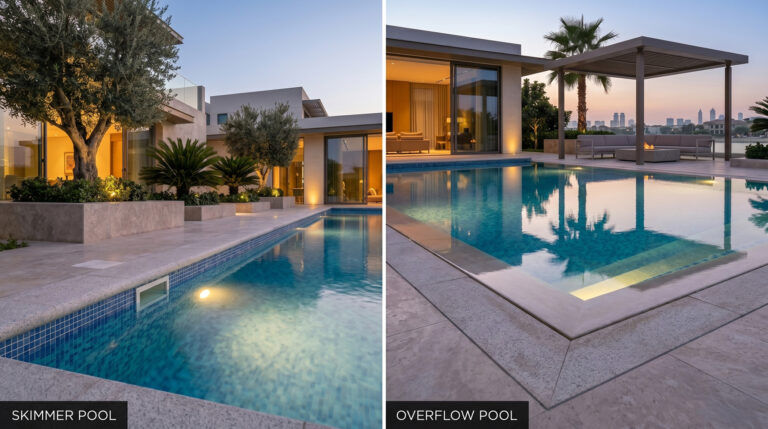
Modern swimming pool projects often involve an important engineering decision during the design stage: choosing between an overflow pool system and a skimmer pool system.
Both systems are widely used in residential and commercial applications, but each offers different advantages in terms of appearance, water circulation, maintenance and project requirements.
Understanding the differences between these systems is essential for homeowners, developers, architects and hospitality investors planning a modern swimming pool project.
In this article, we compare overflow and skimmer pool systems to help determine which solution is best for different applications.
What Is a Skimmer Pool System?
A skimmer pool system uses skimmer units installed along the pool wall to collect floating debris and circulate water through the filtration system.
As water moves through the pool, the skimmer draws surface water into the filtration circuit before returning cleaned water back into the pool.
Skimmer systems are among the most commonly used pool circulation methods in residential projects due to their:
Simpler installation
Lower construction cost
Easier maintenance
Efficient residential performance
Skimmer pools are widely preferred for private homes and smaller-scale developments.
What Is an Overflow Pool System?
Overflow pool systems are designed so water continuously flows over the pool edge into surrounding overflow channels or balance tanks.
The circulated water is then filtered and returned back into the pool system.
Overflow pools are commonly associated with:
Luxury architectural projects
Hotels and resorts
Infinity edge concepts
Commercial aquatic facilities
High-end residential developments
These systems create a visually seamless water surface while improving circulation consistency.
Visual Design Differences
One of the biggest differences between overflow and skimmer systems is visual appearance.
Overflow systems create a clean and continuous waterline effect that is often considered more luxurious and architecturally refined.
This makes overflow systems highly popular in:
Resorts
Boutique hotels
Luxury villas
Infinity edge pool designs
Skimmer systems, while visually simpler, still provide clean and modern aesthetics suitable for many residential applications.
Water Circulation Performance
Overflow systems generally provide more uniform surface circulation because water continuously moves across the entire pool perimeter.
This can improve:
Surface cleaning efficiency
Water circulation balance
Debris collection consistency
Skimmer systems also provide effective circulation but may create slightly less uniform surface movement depending on pool design and skimmer placement.
For many residential applications, skimmer systems still perform very efficiently.
Installation Complexity
Skimmer pool systems are typically easier and faster to install.
They require:
Fewer hydraulic components
Simpler plumbing layouts
Lower construction complexity
Overflow systems usually require:
Overflow channels
Balance tanks
Additional hydraulic engineering
More complex leveling systems
As a result, overflow systems generally involve more advanced construction planning.
Maintenance Considerations
Both systems require regular maintenance for long-term performance.
However, maintenance approaches differ slightly.
Skimmer systems are often considered easier to maintain due to their simpler hydraulic structure.
Overflow systems may require additional monitoring related to:
Overflow channels
Balance tank systems
Water level regulation
Despite this, overflow systems are highly effective in maintaining surface cleanliness and water circulation quality.
Cost Differences
Project budget is another major factor when choosing between these systems.
Skimmer pools are generally more cost-effective because they involve:
Simpler engineering
Reduced hydraulic infrastructure
Faster installation
Overflow systems often involve higher initial investment due to their advanced engineering and luxury-oriented design features.
However, many commercial and hospitality projects consider the visual impact worth the additional investment.
Which System Is Better for Commercial Projects?
Overflow systems are commonly preferred in commercial and hospitality environments because they provide:
Premium visual aesthetics
Uniform water circulation
High-capacity hydraulic performance
Luxury architectural integration
Hotels, resorts and public aquatic facilities frequently use overflow systems to enhance both operational performance and guest experience.
Which System Is Better for Residential Pools?
For residential projects, the ideal system often depends on:
Budget
Design expectations
Installation complexity
Maintenance preferences
Architectural goals
Skimmer systems remain highly popular for private homes due to their practicality and lower construction costs.
Overflow systems are often selected for luxury residential projects seeking premium aesthetics and advanced architectural integration.
Modern Fiberglass Pool Compatibility
Modern fiberglass pool manufacturing supports both overflow and skimmer configurations.
Manufacturers can often provide:
Integrated overflow systems
Infinity edge concepts
Skimmer-compatible pool shells
Project-specific hydraulic adaptations
This flexibility allows developers and distributors to select the most suitable solution for each project.
Conclusion
Both overflow and skimmer pool systems offer important advantages depending on project requirements, architectural goals and operational expectations.
Skimmer systems provide practical and efficient solutions for residential applications, while overflow systems deliver premium aesthetics and enhanced circulation performance for luxury and commercial projects.
Choosing the right system ultimately depends on balancing visual design, engineering complexity, maintenance preferences and project budget.


Comments